Jezebel: What Are We to Make of the Case of Scholar Avital Ronell?

Avital Ronell, a queer professor at New York University

Our thanks to John for this. Extracts:

Ronell, for her part, has denied all allegations of sexual contact and sexual harassment between her and her former graduate student. (Neither she nor her lawyer has responded to numerous requests for interviews from Jezebel.) In a statement to the Times, she described the email exchanges as mutual conversations between two consenting adults. (It’s worth noting that she doesn’t dispute the content of their emails, but rather Reitman’s framing of them as harassment): “Our communications — which Reitman now claims constituted sexual harassment — were between two adults, a gay man and a queer woman, who share an Israeli heritage, as well as a penchant for florid and campy communications arising from our common academic backgrounds and sensibilities. These communications were repeatedly invited, responded to and encouraged by him over a period of three years.”…

The kind of behavior Reitman alleges against Ronell is not an isolated incident, but rather, thrives in a system in which professors wield a wildly disproportionate amount of power over their students, particularly graduate students. Advisors, especially senior faculty like Ronell who are highly regarded in their field, have the ability to dictate the futures of their mentees post-graduation when they enter a market where jobs—especially tenure-track jobs—are increasingly scarce. This is exacerbated by a situation in which the blurring of lines between the personal and professional in the relationships between professors and their graduate students is, if not the norm, not particularly frowned upon and often encouraged. “People know that she is very friendly and open and crosses traditional boundaries in relationships with her students,” [J4MB emphasis] Safit, Ronell’s friend and NYU colleague, told Jezebel.

Ballooning hero becomes a woman for new Eddie Redmayne film “The Aeronauts”

FACT

James Glaisher, left, and Henry Coxwell in the basket of a hot air balloon in about 1862

Times caption: James Glaisher, left, and Henry Coxwell in the basket of a hot air balloon in about 1862

FICTION

Eddie Redmayne and Felicity Jones in The Aeronauts

Times caption: Eddie Redmayne and Felicity Jones in The Aeronauts

Isn’t it inspiring, how courageous women are in works of fiction?

Women are strong.
Women are amazing.
Women need quotas for fictional accounts of courageous achievements.

A piece in today’s Times:

When film-makers decided to plunder the history books for a story of airborne excitement they found what they were looking for in the tale of James Glaisher and Henry Coxwell, with one niggle.

The balloonists and their near-death experience in the skies over Wolverhampton in 1862 would be much better, they reasoned, if one of them were a woman. [J4MB: Why “much better”?]

So while the meteorologist Glaisher will be memorialised in The Aeronauts in a performance by Eddie Redmayne, the daring balloonist Coxwell has been replaced with an imaginary female aeronaut named Amelia Wren. Tom Harper, the film’s writer and director, who oversaw the recent BBC adaptation of War & Peace, has forgone accuracy for the opportunity to place Redmayne opposite Felicity Jones, who starred with him in The Theory of Everything.

The omission of Coxwell has irritated the Royal Society, which argued that there were plenty of female scientists of the period who deserved to have their stories told on film.

Keith Moore, head of library at the scientific institution, said that Coxwell’s story should be better known. “It’s a great shame that Henry isn’t portrayed because he performed very well and saved the life of a leading scientist,” he told The Daily Telegraph. “Glaisher was just looking at his instruments — he was very much the cargo.”

The two men had risen to about four miles above the ground when Glaisher began to feel desperately ill. When he tried to raise one of his arms from where it rested on a table he found that it would not move. He tried to call out to Coxwell, but no words emerged and his head lolled to one side.

“In an instance darkness overcame me,” he wrote afterwards. “I believed I would experience nothing more as death would come unless we speedily descended.”

Unfortunately, the release valve that would allow the balloon to descend had become entangled in ropes and could only be freed if one of the men climbed out of the basket. The air was thin and the temperature fell to minus 29C as Coxwell, a balloonist of great experience, pulled himself up into the shrouds of the balloon. Clinging on with both hands, he used his teeth to operate the valve. [J4MB: This is, of course, the character who will be portrayed as a woman.]

Historians believe that the balloon reached a height of 7 miles (37,000ft or 11,000m) before it was brought under control.

The men fared better than the pigeons they had brought with them for experimental purposes. The one that they dropped over the side at an altitude of three miles “dropped like a piece of paper”. A second, dropped at four miles, flew vigorously in circles while losing height. A third, ejected between four and five miles, “fell downwards as a stone”. [J4MB: Doubtless the male character will be portrayed as the pigeon-lobber.]

Todd Lieberman, the film’s producer, has previously spoken about his wish to make the story authentic, saying: “A top priority for us on The Aeronauts is authenticity. [J4MB: Other than the barefaced lie that one of the two people involved was a woman, anyway.] With that in mind, we intend to do as much balloon filming in the sky as the weather will allow.”

You can subscribe to The Times here.

A levels: Boys benefit from new regime as A*s soar and pass mark falls

A piece in today’s Times by Rosemary Bennett (Education Editor), Nicola Woolcock (Education Correspondent), and Ryan Watts (something else). Emphases ours:

The proportion of pupils getting top grades at A level hit its highest in more than five years even though the reformed exams have been described as the toughest in a generation.

Pass marks were lowered to ensure that enough pupils got top marks, analysis by The Times has discovered.

At Edexcel, the pass mark for an E grade in biology was 24.3 per cent compared with 46 per cent in 2016, before the reforms. In physics it was 21 per cent compared with 50 per cent, in chemistry 22 per cent, against 56 per cent in 2016. A similar pattern emerged at AQA where the pass mark for biology was 19 per cent compared with 41 per cent in 2016.

The official figures showed that 26.4 per cent of exams taken were awarded an A* or A, the highest proportion since 2012.

Boys outperformed girls at the top end, awarded a higher proportion of A*s and As for the second year in a row. It is thought that the decision to scrap course work and modules favours boys’ way of working. [J4MB: Note the ideological bias here. Boys did better than girls because the manipulation designed to advantage girls over boys – teachers’ pro-girl bias manifested through continuous assessment – was ended. This ending of female privilege is spun as “the decision to scrap course work and modules favours boys’ way of working.”] The gender gap remains wide in subjects such as physics, where only 8,384 girls took the subject compared with 29,422 boys. However, more girls than boys studied biology. [J4MB: As we’d expect, on the grounds of gender-typical work ethic. Biology is a less challenging subject to study than, say, physics or mathematics.]

Maths is the most popular subject by far, with 97,627 pupils — one in eight — taking it.

Damian Hinds, the education secretary, said that the redesign of A levels would make them “more appropriate, better [at] preparing young people for moving on to the next stage”.

He told Today on BBC Radio 4: “Having exams at the end of the two years means that it is possible to consider the subject as a whole, to bring in all the different parts of it, to synthesise the different aspects of the subject in a way that is a little closer to undergraduate study.”

Exam boards defended the move to lower the bar, saying that it would be unfair to penalise the first few years of pupils taking the new exams, with teachers unfamiliar with the courses and the increased level of difficulties.

Alan Smithers, professor of education at the University of Buckingham, said that the reforms to create A levels that were “the toughest for a generation” were “a paradox”, adding: “This seems to be because Ofqual, the regulator, is propping them up so the students are not disadvantaged.”

Geoff Barton, general secretary of the Association of School and College Leaders, said that this “propping up”, known as comparable outcomes, questioned whether the exam reforms had been worth it.

Parents would approve because it meant their child would not lose out. “But I think I would be saying, ‘So what was all that juggernaut of reform about, why did we do all that?’” he added.

Head teachers also said that the reforms were narrowing education, with more and more pupils taking three subjects rather than four because the content was so difficult.

There are benefits in pupils taking three subjects that support one another, such as maths, further maths and physics, rather than a spread including a humanities subject or an art.

Humanities are suffering. The numbers taking geography fell to 30,366, down by more than 4,000.

Science subjects continued to grow in popularity. Computer science was the fastest growing subject, and physics, chemistry and biology all had an increase in entries.

Heads are also attempting to estimate the impact of rising numbers of unconditional offers from universities.

At a school in the north of England A* to E passes collapsed after students received an “amazing” number of unconditional offers, according to TES.

The results were reported by the school to Partners in Excellence, a network of schools and sixth-form colleges in England and Wales. Sir John Rowling, group chairman, would not name the school, but said that its A*-E grades had fallen from 74 per cent last year to 14 per cent this year. A total of 40 pupils had received unconditional offers from universities. “Some kids were not even going to school after they received the unconditional offers,” he said. One pupil is off to university having secured two Us and an E, he added.

You can subscribe to The Times here.

Laura Bates: Female Genital Mutilation disproportionately affects women

Pitiful. An extract:

It is undeniable that these problems, and a great many more, from wage inequality to so-called “honour” violence, female genital mutilation to workplace sexual harassment, disproportionately affect women.

The first two parts of a three-part “essay” by Special Snowflake for The Economist titled, “How to convince sceptics of the value of feminism.”

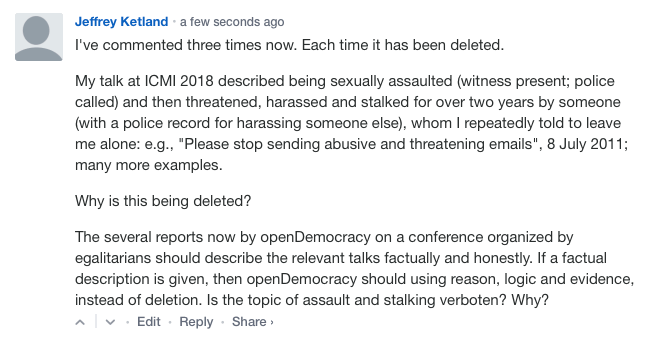
50.50 “Feminism is Cancer” article – Jeff Ketland’s comments removed FOUR times

Jeff Ketland is an academic, the video of his ICMI18 talk “A feminist witch hunt at Oxford University” will be published in coming days. His speaker profile on the ICMI18 website:

Jeff is a professional logician, mathematician and academic philosopher. He was the victim of a female Borderline Personality Disordered stalker for over two years. He was then the victim of a feminist vigilante lynch mob campaign of false accusations, running him out of his job at Oxford and driving him and his family out of their home. He was reinstated after proving the allegations false.

He’s posted the same broad comments on the 50.50 “Feminism is Cancer” piece on three occasions, and each time the moderators have removed them. His screenshot of his latest comments, posted in the early hours of this morning: