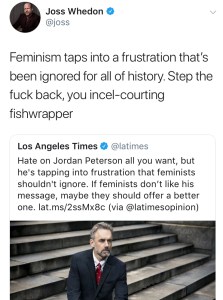
The pathetic howl of the mangina-exposed-as-hypocrite in action. Read more at The Daily Caller.
The pathetic howl of the mangina-exposed-as-hypocrite in action. Read more at The Daily Caller.
“We are no longer a pageant. We are a competition.” according to Gretchen Carlson, chair of the Board of Trustees of the Miss America Organisation and former winner of Miss America, on Good Morning America.
Participants will no longer take part in swimsuit or evening gown parades – but rather an interactive session with the judges where they will have the opportunity to display their intellectual and personal prowess and one in which they’ll don an outfit that expresses their personal sense of style.
The move is intended to empower the participants. Personally, I don’t make a value judgement on the worth of women extracting their sense of empowerment from a) their appearances or b) their intellect – it’s horses for courses, in my opinion. And it seems a shame that increasingly women who do find empowerment in looking great are having their spaces taken away from them – Miss America, darts walk-on girls, grid girls…
Impact on ratings is yet to be seen.
Read more at The Independent or CNN.

An important piece of research is currently being conducted at The University of Manchester, led by Sharon McDonnell, into the impact of bereavement by suicide.
5292 people have participated so far – making it the largest suicide bereavement study internationally already and the study has been referred to in the House of Commons.
Around 810,000 are bereaved by suicide in the U.K. It is a major public and mental health issue, with those bereaved by suicide being at a significant risk of dying by suicide themselves. There is currently no specialist service in NHS to support those bereaved by suicide and health professionals are often anxious and uncertain how to respond to them. Providing better information and support is a key priority in England’s suicide prevention strategy and this research will provide an integral resource for policy makers.
The link to be a part of this study is here.
Our thanks to Ken for this.
Paul Elam has changed the title of his conference talk – which will be delivered by video, because health problems mean he cannot travel to the conference – to the following:
Gender Insanity: Why men and women should be ashamed of themselves.
Our thanks to Tim for this (video, 12:28). We know of other countries where the same insane policy direction took place.
Our thanks to Bryn for this. It’s been known for decades that teachers award girls higher marks than boys for the same quality of work, indeed that knowledge was the driver of the replacement of O Levels by GCSEs in 1987/8, because then teachers’ pro-girl bias could be reflected in higher marks for girls. The significant education gender gap started that year – the gap had been miniscule previously – and has been with us ever since. It’s an issue well explored by William Collins here.
Extracts from the BBC piece:
Teachers are more lenient in their marking of girls’ schoolwork, according to an international study.
An OECD report on gender in education, across more than 60 countries, found that girls receive higher marks compared with boys of the same ability.
Researchers suggest girls are better behaved in class and this influences how teachers perceive their work.
Differences in school results can sometimes “have little to do with ability”, says the study.
The OECD study, examining gender inequality in education, says that girls can be put off careers in science because of a lack of self-confidence and negative stereotypes. [J4MB: How often do we have to read of the female self-confidence issue, and stereotypes? Surely a more plausible explanation is that girls are disinclined to study challenging subjects e.g. STEM – where answers are right, or wrong, so teacher bias plays less of a part? And do girls’ (and women’s) problems with “stereotypes” arise from their anxiety and herd instincts, which aren’t going to change any time soon?]
But it also reveals that teachers can be biased towards giving girls higher results than boys, even when they have produced the same quality of work…
It also raised questions about whether this really benefited girls.
“Is it a good thing? Maybe in the short run, you get a better school certificate,” said the OECD’s education director, Andreas Schleicher. [J4MB: “You” being female, of course. Complete blindness to the other side of the coin, that boys get worse school certificates as a result of this female privileging.]
“In the long run, the world is going to penalise you because the labour market doesn’t pay you for your school marks, it pays you for what you can do.”
Four days ago we published a piece about Rachel Reeves MP (Labour, Leeds West) being “truly staggered” by the decision of the Bank of England to appoint a man to the Monetary Policy Committee. Maybe she was staggered that the outrageously anti-male recruitment process – explored in our piece – had failed to lead to the appointment of the best woman for the job, rather than the best person for the job. Only one man was on the five-person shortlist.
Our thanks to Jack for this piece about PWC. Over the six years I’ve been campaigning through Campaign for Merit in Business against government and corporate initiatives to increase gender diversity on corporate boards – because greater gender diversity leads to financial decline – I’ve had plenty of time to consider why professional service firms (notably accountancy firms and management consultancies) are such arch-supporters of more gender diversity in the upper echelons of businesses. They know the negative impact, and must themselves be seeing it in impaired efficiency, effectiveness, and therefore reduced profitability. The only explanation I’ve ever found credible is that in persuading clients to adopt the policy of increasing gender diversity at senior levels, the clients are weakened and then have to rely more on external support, i.e. professional service firms.
The madness continues. Since when have skirts been “gender neutral”? The start of the piece:
A school has said boys who find trousers too hot in the summer months should instead wear a skirt as part of a ‘gender-neutral’ uniform policy.
Chiltern Edge Secondary School in Oxfordshire has banned boys from wearing shorts and insists those who don’t want to wear trousers must don a skirt.
Leaders at the school in Sonning Common introduced a ‘more formal’ uniform policy at the beginning of the academic year that stipulated that the only leg wear permitted was trousers or skirts.
A tip of the hat to Bettina for this.
 Justice for Men & Boys